

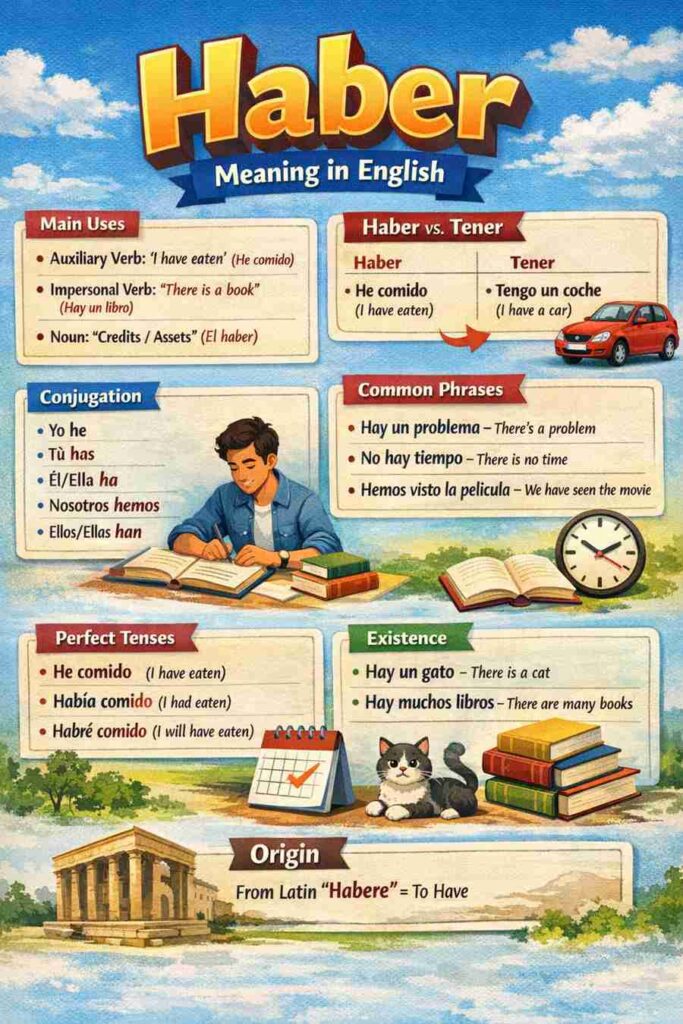
The meaning of haber in English relates to the ideas of “news,” “information,” or “to have,” depending on how the word is applied in Spanish. The term comes from the Spanish verb haber, which functions both as auxiliary verb and as an noun. In daily language, it carries multiple grammatical roles that shape sentence structure and meaning.
When translating into English, usage determines the exact meaning. On one hand, haber indicates possession or existence. On the other side, it functions as part of verb tenses. Spanish learners encounter it early because it forms the backbone of the perfect tenses.
Grammatical Role of Haber in Spanish
In Spanish grammar, haber serves two primary roles:
- Auxiliary verb (helping verb)
- Impersonal verb expressing existence
- Noun form referring to assets or credits (mainly in formal usage)
Here is a simple outline:
| Form of Haber | English Meaning | Usage Example (Spanish) | English Translation |
| He | I have | He comido | I have eaten |
| Has | You have | Has llegado | You have arrived |
| Ha | He/She has | Ha salido | He/She has left |
| Hemos | We have | Hemos visto | We have seen |
| Han | They have | Han terminado | They have finished |
| Hay | There is/There are | Hay un libro | There is a book |
Haber as an Auxiliary Verb
One of the most common uses of haber appears in perfect tenses. Spanish uses haber plus a past participle to describe completed actions.
Examples:
- He estudiado – I have studied
- Hemos viajado – We have traveled
- Han hablado – They have spoken
English uses “have” in a similar way. However, Spanish strictly limits haber to auxiliary functions in compound tenses. It does not express possession in modern usage.
Haber vs. Tener
Learners sometimes confuse haber with tener, which means “to have” in English.
| Word | Meaning | Example | Translation |
| Haber | To have (auxiliary) | He terminado | I have finished |
| Tener | To own/possess | Tengo un coche | I have a car |
In modern Spanish, tener expresses ownership. Haber no longer carries that function in daily speech. Historically, it once expressed possession, but that role shifted over time.
As an Impersonal Verb
The form hay represents one of the most common Spanish expressions. It means “there is” or “there are.”
Examples:
- Hay un problema – There is a problem
- Hay muchas opciones – There are many options
Notice that hay remains the same for singular and plural nouns. English changes between “is” and “are,” while Spanish keeps one form.
Other impersonal forms exist in different tenses:
- Había – There was / There were
- Habrá – There will be
- Hubo – There was (completed past event)
These forms help describe existence rather than possession.
Origin and Etymology
The word haber traces back to Latin habere, which meant “to have” or “to hold.” Over centuries, its role evolved in Spanish grammar. English retained “have” as both an auxiliary and a possession verb, but Spanish divided those responsibilities between haber and tener.
This linguistic shift explains why direct translation sometimes causes confusion.
Haber in Legal and Financial Contexts
In formal documents, haber appears as a noun. In this sense, it refers to assets, credits, or entitlements.
For example:
- “El haber del empleado” refers to the employee’s earnings.
- In accounting, haber may refer to the credit side of a ledger.
This usage differs from everyday conversational Spanish and appears more in technical writing.
Within Media and News Writing
The word haber itself does not directly translate to “news,” but it connects indirectly to Spanish media language. The Spanish word for news is noticias. However, phrases like “haber de” sometimes express obligation or future intent in journalistic writing.
Just like:
- Ha de anunciar cambios – He must announce changes
This structure adds nuance to formal announcements.
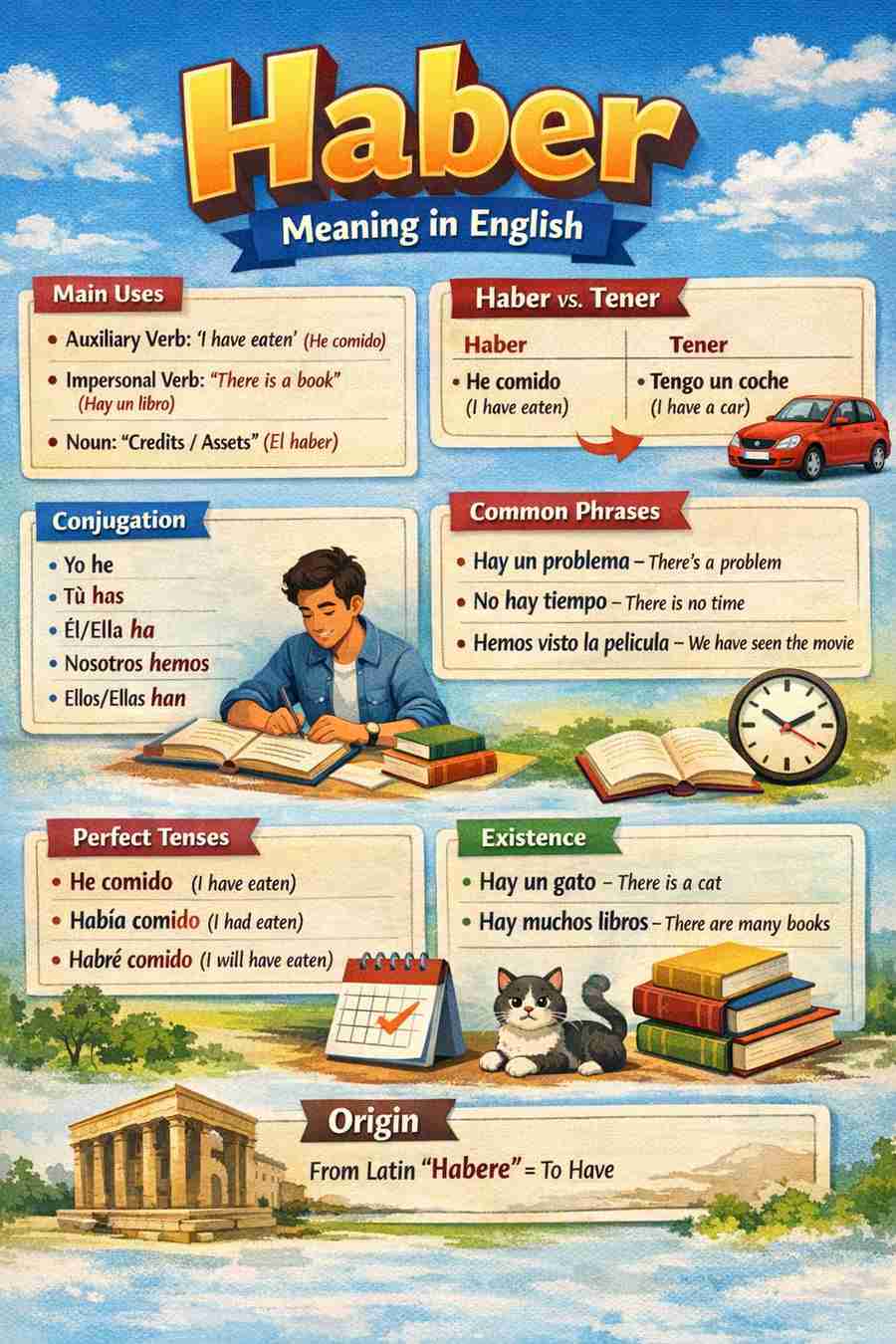
Conjugation of Haber in Present Tense
Following is the full present tense conjugation:
- Yo he
- Tú has
- Él/Ella ha
- Nosotros hemos
- Vosotros habéis
- Ellos han
These forms combine with past participles ending in:
- -ado (hablado)
- -ido (vivido)
Spanish grammar relies heavily on this structure in daily conversation.
Past and Future Forms
Haber changes depending on tense. Here is a simplified overview:
| Tense | Example | Translation |
| Present Perfect | He comido | I have eaten |
| Past Perfect | Había comido | I had eaten |
| Future Perfect | Habré comido | I will have eaten |
| Conditional Perfect | Habría comido | I would have eaten |
Each tense conveys timing and completion.
Haber vs. There Is / There Are
English separates singular and plural forms:
- There is a book
- There are books
Spanish simplifies this:
- Hay un libro
- Hay libros
This single-form structure reduces complexity but requires attention to noun agreement.
Summarizing Main Functions
| Function | Description | English Equivalent |
| Auxiliary verb | Forms perfect tenses | Have/Has |
| Impersonal verb | Expresses existence | There is/are |
| Noun (formal) | Refers to credits/assets | Credit/Earnings |
Pronunciation Guide
For clarity, Haber is pronounced:
Ah-BEHR
- The “h” remains silent.
- Stress falls on the second syllable.
Phonetic representation: /aˈβeɾ/
Spanish pronunciation remains consistent, making it easier than irregular English verb sounds. Clear awareness of its roles prevents confusion and strengthens communication skills.