

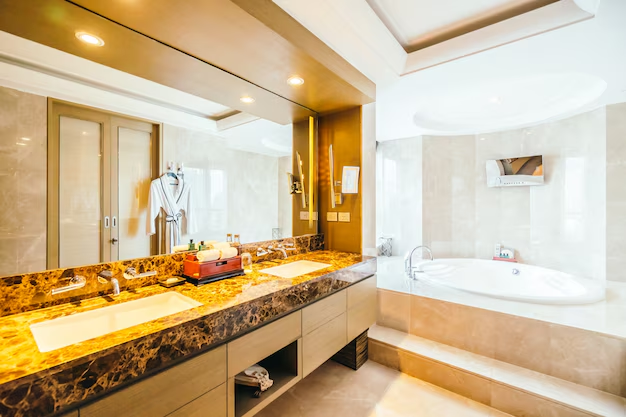
A bathroom mirror does more than provide a place to check your appearance. In commercial properties, it contributes to the room’s overall design, lighting, cleanliness, and usability. From hotels and restaurants to offices, retail spaces, and healthcare facilities, commercial bathroom mirrors need to balance appearance with practical demands. Luxurious Glass offers glass solutions that can help businesses create polished restroom interiors while maintaining the durability needed for regular public use.
Why Commercial Restrooms Need the Right Mirror
Public and commercial bathrooms experience far more traffic than most residential bathrooms. A mirror may be touched, cleaned, exposed to moisture, and used continuously throughout the day. Choosing a suitable product therefore requires more thought than simply selecting a size and frame.
The mirror should fit the proportions of the wall, work with the available lighting, and complement other finishes such as countertops, faucets, wall tile, and partitions. Safety also deserves attention, particularly in busy environments where accidental impact is possible.
A well-planned mirror installation can make a restroom feel larger and brighter. Large reflective surfaces distribute available light across the space, while carefully positioned mirrors make individual sinks easier and more comfortable to use.
Choosing the Right Mirror Style
Commercial bathrooms can accommodate several mirror designs. The best choice depends on the property’s architecture, maintenance requirements, and desired appearance.
Frameless Mirrors
Frameless mirrors offer a clean appearance that works particularly well with contemporary restroom interiors. The absence of a visible frame creates a simple visual line and allows the reflective surface to blend naturally with surrounding materials.
They are commonly used above long vanity counters because several mirror sections can create a consistent appearance across multiple sinks.
Framed Mirrors
Framed mirrors introduce additional visual character. Metal, wood-look, and other frame finishes can coordinate with lighting fixtures, cabinetry, doors, and hardware.
They can be particularly suitable for hospitality environments where the restroom forms part of a carefully designed guest experience.
Custom Shape Mirrors
Standard rectangular mirrors are practical, but custom shapes can create a distinctive interior. Rounded corners, arched profiles, circles, and other designs can soften a space or reinforce an architectural theme.
Custom fabrication is useful when walls, vanity dimensions, columns, or other features make standard mirror sizes unsuitable.
Full Wall Mirrors
A large mirror extending across much of a vanity wall can create a strong visual effect. It also provides reflection for several users without requiring individual mirror panels.
Proper planning is essential for larger installations because transportation, handling, wall support, and positioning become more demanding as mirror dimensions increase.
Selecting the Right Glass and Safety Features
Glass selection should reflect the environment where the mirror will be installed. Commercial bathrooms need materials that can withstand regular cleaning and daily use without creating unnecessary maintenance problems.
Safety-backed or safety-oriented mirror products can be considered for locations where additional protection is needed. Depending on the application and local requirements, backing systems may help reduce the risk associated with broken glass.
Moisture is another consideration. Bathrooms naturally expose materials to humidity and water. Proper edge treatment, suitable mounting methods, and quality installation can help protect the mirror and surrounding surfaces.
Businesses should also check applicable building codes, accessibility requirements, and project specifications before ordering mirrors. Requirements can vary based on the property type and jurisdiction.
Getting the Dimensions Right
Accurate measurements are one of the most important parts of a successful mirror project. Before ordering, measure the available wall area and consider the location of sinks, faucets, lights, outlets, dispensers, and other fixtures.
For vanity installations, the mirror should relate proportionally to the countertop and sink arrangement. A mirror that is too narrow may look disconnected from the vanity, while an oversized mirror can interfere with lighting or nearby fixtures.
For multiple mirrors, determine whether the installation will use individual panels or one continuous surface. The spacing between panels should be planned before fabrication.
It is also useful to account for installation tolerances. Walls are not always perfectly level or square, particularly in older commercial properties. Measurements should therefore be verified at the site rather than relying solely on architectural drawings.
Mirror Placement and Accessibility
Height and placement affect both appearance and usability. A commercial restroom may serve people of different heights and abilities, so mirror positioning should be considered alongside applicable accessibility standards.
The location should provide a useful reflection without obstructing faucets, lighting, dispensers, hand dryers, or other equipment. In accessible restroom layouts, mirror height and viewing angles may have specific requirements.
The mirror should also be positioned so users can comfortably approach the vanity. Crowded layouts can make even an attractive restroom inconvenient to use.
For hospitality and retail properties, placement can also influence the visual perception of the room. A well-positioned mirror can reflect decorative lighting, tile patterns, or architectural details without creating distracting glare.
Lighting Makes a Major Difference
Mirror selection and lighting should be planned together. Even a high-quality mirror can perform poorly if the surrounding lighting creates strong shadows or glare.
Vertical lighting placed beside the mirror can provide more balanced facial illumination than a single light positioned directly above. Backlit mirrors offer another option, particularly for upscale hospitality and office environments.
The color temperature of the lighting also affects the appearance of the room. Warm lighting can create a softer atmosphere, while cooler lighting may produce a cleaner, brighter appearance.
Avoid placing strong light sources directly in front of the reflective surface where they can create uncomfortable glare. During the design stage, consider what users will see from different positions in the restroom.
Installation Methods for Commercial Bathrooms
The installation method depends on the mirror’s dimensions, weight, wall construction, and design.
Adhesive mounting can work for certain mirror applications when the wall surface and adhesive system are appropriate. Mechanical fasteners, clips, channels, or specialized mounting hardware may be preferable for larger or heavier installations.
Before installation, the wall should be inspected for suitable support and surface conditions. Painted drywall, tile, concrete, and other substrates may require different preparation and hardware.
For large mirrors, professional handling is strongly recommended. Glass panels can be difficult to maneuver through commercial corridors, doorways, and finished interiors. Proper lifting and positioning also reduce the possibility of damage during installation.
Installers should follow the mirror manufacturer’s recommendations for adhesives, fasteners, clearances, and curing times. Rushing these steps can result in movement, stress, or premature failure.
Maintaining Mirrors in High Traffic Areas
Commercial restroom mirrors require frequent cleaning, but aggressive cleaning practices can shorten their service life.
Use products recommended for mirror surfaces and apply them to a soft, lint-free cloth rather than allowing excessive liquid to collect around the edges. Standing moisture around the perimeter can contribute to deterioration over time.
Avoid abrasive pads, harsh scraping tools, and cleaners that may damage the surface or backing. Regular cleaning schedules should also include inspections for chips, cracks, loose hardware, or edge deterioration.
Facilities with heavy restroom traffic may benefit from scheduled maintenance checks. Catching small problems early can prevent more disruptive repairs later.
Common Mistakes to Avoid
Several problems can be prevented during the planning stage.
Ordering before final measurements: Construction changes can affect wall dimensions, vanity placement, and fixture locations.
Ignoring lighting: A mirror may look excellent on a sample wall but perform poorly under badly positioned lights.
Choosing appearance over durability: Commercial interiors need materials suited to frequent use and cleaning.
Skipping wall preparation: Uneven or unsuitable surfaces can create installation difficulties.
Using residential hardware for commercial applications: Larger mirrors often require stronger and more appropriate mounting systems.
Forgetting maintenance access: Mirrors installed too close to fixtures or difficult-to-reach areas can make cleaning unnecessarily complicated.
Creating a Polished Commercial Restroom
A successful mirror installation begins before the mirror reaches the job site. Designers, contractors, facility managers, and glass professionals should coordinate dimensions, materials, lighting, accessibility, mounting, and maintenance requirements early in the project.
The result should suit the character of the property while standing up to everyday use. A carefully selected mirror can make a compact restroom feel more open, support better lighting, and provide a finished appearance that complements the rest of the interior.
Final Thoughts
Commercial bathroom mirrors should be selected as part of the entire restroom design rather than treated as an afterthought. Size, glass type, safety considerations, placement, lighting, mounting, and maintenance all influence the finished result. Working with an experienced glass professional can make the process easier, particularly for custom sizes or larger installations. For businesses planning a new restroom or upgrading an existing space, contact us today to discuss mirror options suited to the project and installation requirements.