

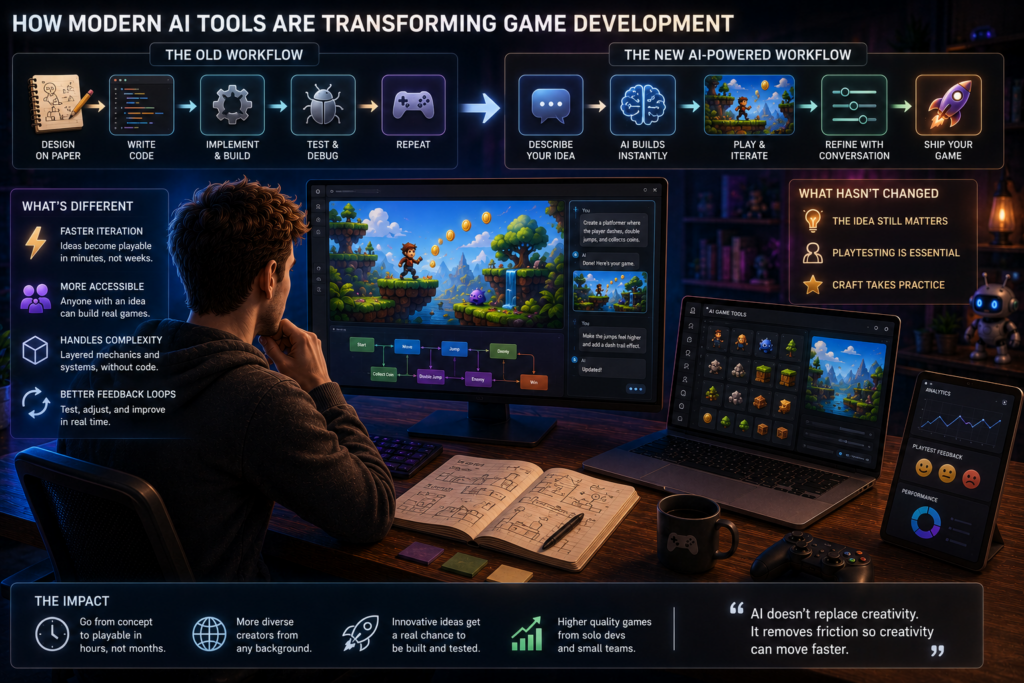
Game development has changed more in the last few years than it did in the two decades before that. Not because the fundamentals of good design shifted, they haven’t, but because the tools standing between an idea and a playable version of it have been completely rebuilt. Modern AI tools aren’t just making existing workflows faster. They’re changing what a workflow even looks like from the ground up.
The Old Workflow Versus the New One
Traditional game development followed a fairly rigid sequence: design on paper, learn or apply the technical skills needed to build it, implement it in code, test, debug, and repeat. Each of those stages took real time, and moving from one to the next required specific expertise that had little overlap with creative decision-making itself. Modern AI tools compress that sequence dramatically, letting a designer move from a described idea to a playable version without the technical implementation stage acting as a bottleneck in between.
This isn’t a minor efficiency gain. It changes the actual shape of the creative process, since ideas no longer need to survive a long technical delay before they can be tested and felt.
What’s Actually Different About Modern AI Tools
Understanding Intent, Not Just Commands
Earlier generations of accessible tools often required fairly rigid input, specific menus, limited customization, predefined templates dressed up as flexibility. Modern AI tools work differently, interpreting a genuine, conversational description of what a creator wants and translating that into functioning mechanics. The gap between what someone means and what actually gets built has narrowed significantly.
Real-Time Iteration Instead of Rebuild Cycles
Adjusting a game used to mean returning to code, making a change, and waiting to see the result play out correctly. Modern tools collapse that cycle into something closer to a conversation, describe the change, see it reflected almost immediately, and keep refining from there. That speed changes how much experimentation a creator is willing to do, since each attempt costs almost nothing compared to before.
Handling Genuine Complexity, Not Just Simple Mechanics
Early accessible tools tended to top out at fairly basic mechanics before hitting a ceiling. Modern AI-powered platforms handle considerably more complexity, layered systems, varied mechanics, and refined feel, without requiring a creator to understand what’s happening structurally underneath. Papercut.io is a good example of this in practice, a genuinely inventive mechanic with real polish, showing that modern tools can support ideas well beyond simple templates.
How This Is Changing Who Builds Games
Solo Creators Working at a Pace That Used to Require a Team
A single person using AI games tools can now move through iteration cycles that once required an entire technical team just to keep pace with. That shift is quietly redefining what a solo developer can realistically accomplish, since the bottleneck that used to separate individual creativity from team-level output has largely disappeared.
People With Ideas but No Technical Background
Plenty of people have always understood what makes a game fun without ever having the technical skill to prove it. Modern AI tools finally let that instinct translate directly into something playable, without years of unrelated technical training standing in the way first.
Faster Validation of Niche or Unconventional Ideas
Unusual game concepts that might never have justified a traditional studio’s investment can now get built and tested cheaply enough to find out whether they actually work. That lower cost of experimentation means more genuinely different ideas get a real chance to prove themselves instead of getting filtered out before anyone even tried.
What Hasn’t Changed Underneath All This
The Idea Still Has to Be Good
Faster tools don’t manufacture good ideas. They remove the technical delay between having one and testing it. The judgment required to know whether a mechanic is actually fun, whether pacing feels right, whether a design choice serves the experience, still comes entirely from the person building the game.
Testing With Real Players Still Matters Most
No amount of tool sophistication replaces watching an actual player interact with a game and adjusting based on what happens. If anything, faster iteration makes that feedback more valuable, since there’s more room to act on it before a design gets locked in.
Craft Still Develops Over Time
Understanding what separates a good mechanic from a mediocre one still takes practice and attention, regardless of how quickly an idea can be prototyped. Modern tools shorten the distance between concept and execution. They don’t shortcut the experience needed to know what’s worth building in the first place.
Where This Is Headed Next
The trajectory so far suggests these tools will keep closing the gap between imagination and execution rather than plateauing. As iteration keeps getting faster and platforms keep handling more complexity without added difficulty, the practical difference between a trained developer and a determined newcomer keeps shrinking. That doesn’t mean expertise stops mattering, it means expertise increasingly shows up in design judgment rather than technical execution, which is arguably where it always should have lived.
Final Thoughts
Modern AI tools are transforming game development by finally letting the technical side of building a game keep pace with the creative side, rather than slowing it down. The result isn’t a lower bar for what counts as real development, it’s a shift in where the real skill lives, in the ideas, the iteration, and the judgment calls that were always the hardest part to teach in the first place.