

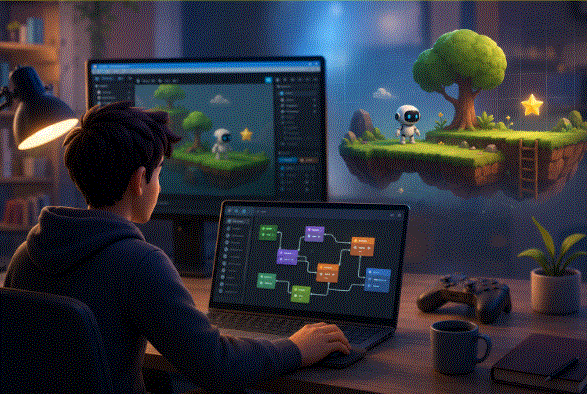
Simplifying something is easy to get wrong. Strip away too much and you end up with a tool that only produces shallow, forgettable results. No-code game makers had to solve a harder problem than that, removing the technical complexity of development without removing the depth that makes a game actually worth playing. Understanding how they manage that balance explains why they’ve become genuinely useful rather than just accessible.
What “Simplifying” Actually Means Here
Simplifying game development doesn’t mean making games simpler. It means removing the technical steps that used to stand between an idea and a working version of it, without touching the creative depth a game can still have. That distinction matters, because a lot of people assume accessible tools automatically produce shallow results. In practice, the complexity gets moved, not eliminated, handled by the platform instead of demanded from the creator.
How No-Code Tools Actually Simplify the Process
Removing Syntax as a Requirement
Traditional development required knowing the exact structure a programming language expected, precise syntax, correct function names, specific logical formatting. No-code tools remove that requirement entirely, letting a creator describe what they want in ordinary language instead. This is the single biggest simplification, since syntax errors used to account for an enormous amount of wasted time that had nothing to do with actual design decisions.
Turning Debugging Into Description
In traditional development, fixing something that didn’t work required understanding why it broke at a technical level. No-code platforms simplify this by letting a creator simply describe the problem or the desired change, rather than tracing through code to locate the issue manually. This removes one of the most frustrating and time-consuming parts of the old process.
Making Iteration a Direct Conversation
Adjusting a mechanic in traditional development meant returning to code, making a change, and testing whether it worked as intended. No-code tools simplify that loop into something closer to a back-and-forth conversation, describe the adjustment, see it reflected, refine further. That directness removes a layer of technical translation that used to slow every round of iteration down.
What Gets Simplified Without Getting Lost
Complexity Moves, It Doesn’t Disappear
A common misconception is that no-code tools work by limiting what’s possible. In reality, the platform absorbs the technical complexity that a creator would otherwise need to manage manually, while still allowing for layered mechanics, varied systems, and genuine depth. The simplification happens in how a creator interacts with that complexity, not in how much complexity the final game can actually contain.
Creative Decisions Stay Exactly as Demanding
Simplifying the technical side doesn’t simplify the creative side. Pacing, balance, difficulty curves, and overall feel still require the same judgment they always have. What’s removed is the unrelated technical labor that used to sit between a creative decision and seeing that decision reflected in a playable version.
A Practical Example of Simplified Development in Action
Mansion Merge shows what this simplification actually produces, a genuinely well-tuned merge mechanic with real depth and polish, built through a process that removed technical friction without flattening the creative result. It’s a clear example of simplification working the way it’s supposed to, easier to build, not shallower to play.
Who Benefits Most From This Simplification
People Who Understand Games but Never Learned to Code
A large share of people using a no-code game maker already have strong instincts for what makes a game fun, they simply never had a technical path to act on those instincts. Removing the coding requirement doesn’t teach them anything new about design, it finally gives their existing judgment somewhere to go.
Small Teams Needing to Move Faster
Teams without a dedicated technical specialist benefit enormously from a simplified process, since implementation no longer creates a bottleneck around a single skill set. This lets small teams move through iteration cycles that would otherwise require additional hires or significant delays.
Anyone Testing Whether an Idea Is Worth Pursuing
Simplification lowers the cost of finding out whether a concept actually works. Instead of committing weeks to learning implementation before testing an idea, a creator can find out almost immediately whether a concept holds up, which makes experimentation far less risky than it used to be.
What Simplification Doesn’t Handle
Knowing What Makes a Mechanic Fun
No-code tools execute what’s described, they don’t judge whether the result is genuinely enjoyable. That evaluation still depends entirely on the creator’s own sense of design, tested honestly against real players rather than assumed from the platform’s output alone.
Replacing the Need for Playtesting
Simplified development still needs to be validated the same way any game does, by watching real players interact with it. No amount of ease in building replaces the value of seeing where a mechanic genuinely lands or falls flat.
Teaching Design Sense Automatically
Understanding pacing, balance, and player psychology still takes time and attention to develop, regardless of how simple the building process becomes. These tools remove a technical obstacle. They don’t shortcut the experience needed to know what’s actually worth building.
Final Thoughts
No-code game makers simplify development by removing the technical burden that used to stand between an idea and a playable version of it, not by reducing what a game can actually become. The complexity that once lived in syntax and implementation now lives entirely in creative judgment, which is exactly where it should have been all along.